Performance Marketing
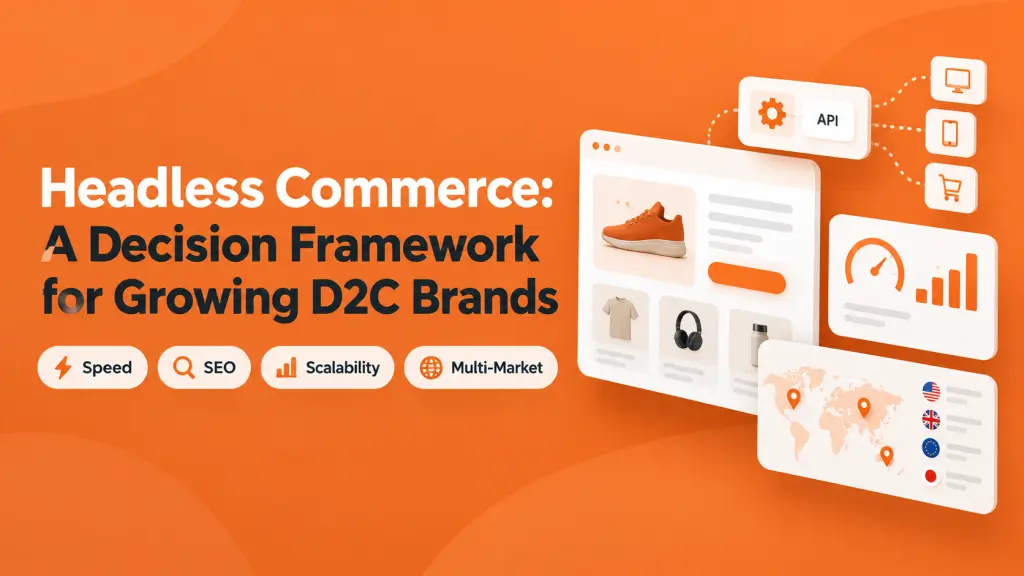
Headless Commerce: A Decision Framework for Growing D2C Brands
Is headless commerce worth it for your D2C brand? Use our 5-signal scorecard to decide when to switch, when to stay, and how to roll out.

Baymard Institute’s research puts average cart abandonment at roughly 70%, and a slow, rigid storefront is one of the quiet reasons shoppers leave. Headless commerce promises to fix that, but it also promises bigger invoices, longer timelines and more moving parts.
So is it worth it? This framework for growing D2C brands gives you a clear, scorable way to decide. You will learn what headless really changes, the five signals that justify the switch, when to stay put, and how to roll it out without wrecking your SEO or ad performance.
What Headless Commerce Means for D2C Brands
Headless commerce separates your front end (what customers see) from your back end (products, carts, checkout, inventory). The two talk through APIs, so you can build a custom storefront while Shopify, BigCommerce or commercetools keeps running the engine.
Why does that matter? Speed and flexibility. Google reports that 53% of mobile visits are abandoned when a page takes longer than three seconds to load. A well-built headless front end, often on frameworks like Next.js or Hydrogen, can serve pages far faster than a theme loaded with apps.
The trade-off is real:
- More control over design, content and page speed
- More complexity in development, QA and maintenance
- Higher cost at launch and over time
Headless is a growth tool for specific situations. It is not a trophy.
The 5-Signal Scorecard: A Framework for Growing D2C Brands
Score each signal from 0 (not true for us) to 2 (very true for us). A total of 7 or more suggests headless is worth serious evaluation.
Signal 1: Performance Is Capping Your Growth
A Deloitte study for Google found that a 0.1 second improvement in mobile site speed lifted retail conversions by 8.4%. If your Core Web Vitals are stuck in the red despite theme and app cleanup, the front end may be your ceiling.
Signal 2: Your Content and Campaigns Outpace Your Theme
Do you launch landing pages weekly, run heavy personalization or publish rich editorial content? If your marketing team waits on developers for every layout change, you are losing speed. Headless paired with a good CMS lets marketers ship without breaking the store.
Signal 3: You Sell Across Markets or Channels
Selling in India, the US, UK, Canada, Australia and Europe means multiple currencies, languages, tax rules and payment methods. Headless lets you run one commerce engine with several tailored storefronts, plus apps, kiosks or marketplaces from the same data.
Signal 4: You Have the Team to Support It
Headless needs ongoing engineering, not a one-time build. Ask honestly: do you have in-house developers or a reliable agency partner for monitoring, updates and fixes? If the answer is no, score yourself 0 here and think twice.
Signal 5: The ROI Math Works
Take your current monthly revenue, estimate a realistic conversion lift (start with 5% to 10%) and compare the annual gain against build and maintenance costs. If payback takes longer than 12 to 18 months, wait.
For a deeper look at how we model this for brands, see our evidence page.
When to Stay on a Standard Platform
Many brands grow profitably without ever going headless. Consider staying put if:
- Revenue is still below the stage where a 5% to 10% lift covers the extra cost
- Your catalog is simple and your campaigns are standard
- You depend heavily on plug-and-play apps and native checkout
Native checkout matters more than most founders admit. Shopify reports that Shop Pay can lift checkout conversion by up to 50% compared with guest checkout, and you keep that advantage only if you handle checkout carefully in a headless build.
Often the smarter first move is optimization: clean up apps, compress media, fix Core Web Vitals and improve your offer. Our team covers these fixes in our services overview.
Headless SEO and Performance Marketing Pitfalls
Going headless can hurt revenue if the details slip. Google confirms that Core Web Vitals are part of its page experience signals, which means a poorly built headless site can lose rankings fast.
Watch these risks closely:
- Rendering: Use server-side rendering or static generation so Google can crawl every product and collection page.
- Migration: Map every URL, keep redirects clean and preserve metadata, schema and internal links.
- Tracking: Rebuild your Meta, Google Ads and analytics events server-side and test them before launch.
- Apps: Reviews, subscriptions and loyalty tools may need API-based replacements.
Performance marketers should treat tracking as a launch blocker. A beautiful store that breaks attribution will quietly drain your ad budget.
A Phased Rollout for Growing D2C Brands
You do not need to rebuild everything at once. A phased path reduces risk:
- Audit your current speed, SEO, tracking and conversion funnel.
- Pilot headless on a single high-impact area, such as landing pages or a collection template.
- Measure conversion rate, speed, organic traffic and revenue per visitor against your baseline.
- Expand to the full storefront only when the pilot proves the lift.
Remember that Baymard’s roughly 70% abandonment benchmark means even small, proven gains compound quickly at scale. Browse real examples in our insights library.
Frequently Asked Questions
What is headless commerce in simple terms?
Headless commerce splits the customer-facing storefront from the back-end commerce engine. They connect through APIs, which gives you full design freedom and faster pages.
Is headless commerce good for small D2C brands?
Usually not at first. Smaller brands often get better returns from optimizing a standard Shopify setup before investing in a custom front end.
How much does headless commerce cost?
Costs vary widely by scope, platform and team, but expect higher build and maintenance costs than a theme-based store. Model the ROI before you commit.
Does headless commerce improve SEO?
It can, through faster load times and cleaner code, but only with proper server-side rendering, redirects and metadata. A weak migration can hurt rankings.
When should a D2C brand switch to headless?
Consider it when speed limits conversions, you run multi-market storefronts, your team needs faster content launches and the ROI payback sits within 12 to 18 months.
Can I go headless on Shopify?
Yes. Shopify supports headless builds through its Storefront API and Hydrogen framework, so you can keep its checkout and back end while customizing the front end.
How long does a headless migration take?
Most projects take several months, depending on catalog size, integrations and design complexity. A phased pilot can deliver results sooner.
Ready to Find Out If Headless Is Right for You?
The right answer depends on your numbers, your team and your growth goals, not on industry hype. Global Surat helps D2C brands across India, the US, UK, Canada, Australia and Europe make this call with data, then execute across SEO, performance marketing, web development and AI creative.
Book your strategy consultation today and get a clear, scored recommendation for your store. Start at https://globalsurat.com/ and let’s build your next stage of growth together.
Make this useful