
Performance Marketing
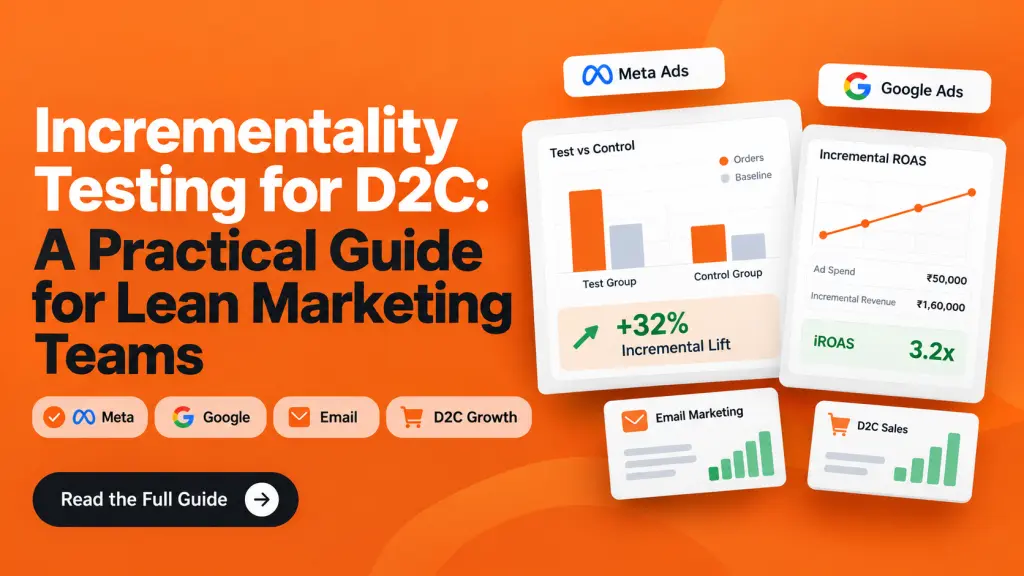
Incrementality Testing for D2C: A Practical Guide for Lean Marketing Teams
Learn why blended MER is now replacing platform ROAS, how to calculate your break-even MER, and build a D2C measurement stack you can trust.

Meta, Google, and your email platform can each claim credit for the same order. Add up their dashboards and you often get more revenue than your store actually booked.
Incrementality testing for D2C solves this by answering one question: how many sales would have happened anyway, without this ad or channel? This guide shows lean teams how to run clean tests without a data science department, read the results, and move budget with confidence.
What Incrementality Testing for D2C Actually Means
Incrementality testing measures the extra conversions caused by a marketing activity. You compare a group that sees your ads (the test group) with a similar group that does not (the control group). The gap between them is your true lift.
This is different from attribution, which only assigns credit to touchpoints a customer happened to click or view.
Attribution tells you who touched the order.
Incrementality tells you who caused the order.
For brands spending real money across Meta, Google, and marketplaces, that difference decides whether a campaign is profitable or just well-timed. Our services team builds measurement frameworks around this idea from day one.
Why Attribution Alone Misleads Lean Teams
Platform reporting got shakier after Apple's App Tracking Transparency rollout. Industry trackers such as Flurry reported opt-in rates hovering around 25% in the US, which means a large share of iOS conversions is now modeled rather than observed.
Three patterns inflate results for D2C brands:
- Branded search capture: Shoppers who already planned to buy click your brand ad, and the platform takes credit.
- Retargeting overlap: Buyers close to purchase see ads they did not need.
- View-through windows: Impressions get credited for orders driven by email, word of mouth, or organic social.
A common finding in lift studies is that retargeting and branded search show far lower incremental returns than their reported ROAS suggests, while prospecting often looks weaker in dashboards than it truly is. Without a test, you may be cutting your best growth channel.
Three Incrementality Test Designs for Lean Budgets
You do not need an expensive vendor. Pick the design that fits your channel mix and traffic volume.
1. Audience Holdout Tests
You split an audience and withhold ads from a random slice, typically 10% to 20%. Meta's Conversion Lift and Google's lift tools automate this inside the platform.
This works best when you have steady daily conversions and want a quick read on one channel.
2. Geo-Based Incrementality Tests
You pause or reduce spend in matched regions and compare sales against regions where spend continues. Most geo experiments run three to four weeks to capture a full buying cycle.
This suits brands in India, the US, the UK, and Australia, where state or city level sales data is easy to pull. It also captures cross-channel effects that platform tools miss.
3. Time-Based On/Off Tests
You switch a channel off for a short window and measure the dip in total revenue. It is the simplest method, but seasonality and promotions can distort it.
Use it only when the other two options are impossible, and keep the window short.
A Step-by-Step Incrementality Testing Framework for D2C
Here is a lean process any small team can follow.
- Write one clear hypothesis. Example: "Pausing branded search for 21 days will reduce total orders by less than 5%."
- Choose a single primary metric. Use total new-customer orders or net revenue, not platform-reported conversions.
- Check your sample size. Aim for at least 100 conversions per group during the test, or the result will be noise.
- Lock the variables. Avoid launching sales, new creatives, or pricing changes during the test window.
- Run the full duration. Ending early because the numbers look good is the fastest way to fool yourself.
- Document everything so future tests build on past learning. Our evidence page shows how structured testing turns into compounding results.
How to Read Your Results: iROAS and Lift
The key metric is incremental ROAS (iROAS):
If your dashboard shows a 4.0 ROAS but the test shows an iROAS of 1.6, the channel still works, but you were overpaying for credit it did not earn. Compare iROAS against your break-even ROAS, which you can calculate from gross margin: break-even ROAS = 1 ÷ gross margin.
A brand with a 50% gross margin breaks even at 2.0. Anything below that is losing money on a true incremental basis, whatever the dashboard says.
Then act on the finding:
- iROAS well above break-even: scale spend in steps of 15% to 20%.
- iROAS near break-even: optimize creative, offers, and targeting before scaling.
- iROAS below break-even: cut or restructure the channel and retest.
Common Incrementality Testing Mistakes to Avoid
- Testing too many channels at once, which makes it impossible to isolate cause.
- Using tiny geos, where one viral post skews the result.
- Ignoring confidence intervals. A 3% lift with a wide margin of error is not a win.
- Treating one test as permanent truth. Incrementality shifts with seasons, creatives, and competition, so retest your largest channels every two to three quarters.
For more measurement playbooks, browse our insights library.
Frequently Asked Questions
What is incrementality testing in marketing?
Incrementality testing is a controlled experiment that measures how many conversions were caused by a marketing activity, by comparing an exposed group with an unexposed control group.
How is incrementality different from attribution?
Attribution assigns credit to touchpoints along the customer journey. Incrementality measures whether the marketing actually caused the sale, which makes it a more reliable guide for budget decisions.
How much budget do I need for incrementality testing for D2C?
You can start with platform lift tools at no extra cost. Geo and holdout tests mainly require enough daily conversions, usually 100 or more per group, rather than a large budget.
How long should an incrementality test run?
Most tests run two to four weeks. The window should cover at least one full buying cycle and avoid major sales events or promotions.
What is a good incremental ROAS?
A good iROAS is one that clears your break-even ROAS, calculated as 1 divided by gross margin. For a 50% margin brand, anything above 2.0 is profitable on an incremental basis.
Can small D2C brands run incrementality tests?
Yes. Small brands can use simple geo splits or platform holdouts. The key is a clear hypothesis, a single variable, and enough conversion volume to read the result.
How often should I retest a channel?
Retest your biggest spend channels every two to three quarters, or after major changes in creative, offers, pricing, or market conditions.
Stop Guessing Which Ads Actually Drive Sales
Every rupee, dollar, or pound spent on unproven credit is margin you could reinvest in real growth. Global Surat helps D2C brands across India, the US, the UK, Canada, Australia, and Europe design lean incrementality programs that connect SEO, performance marketing, and creative into one measurable system.
Book a strategy consultation with the team at Global Surat and find out what your ad spend is really earning.
Make this useful