AI Creative
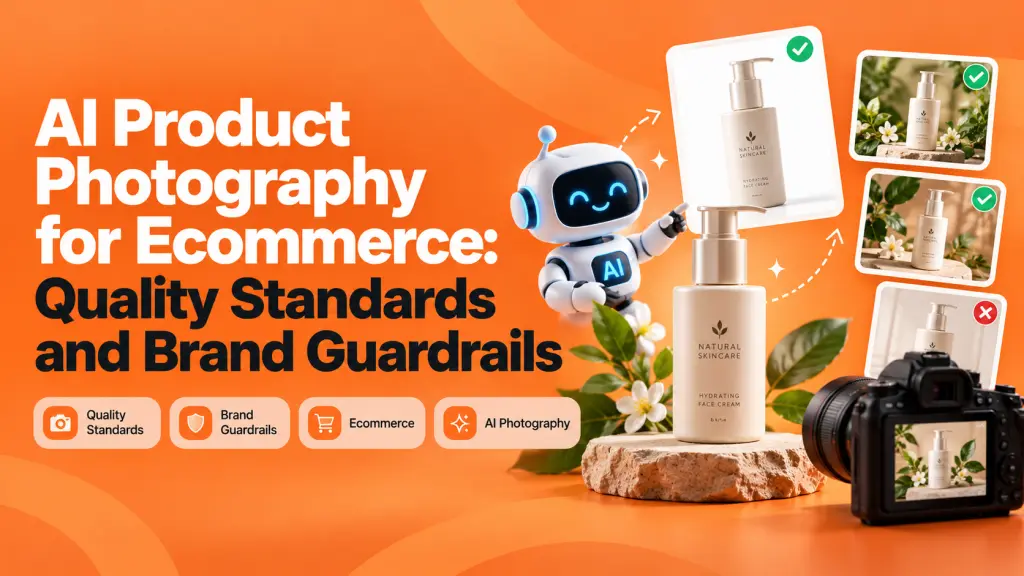
AI Product Photography for Ecommerce: Quality Standards and Brand Guardrails

Roughly one in five online returns happens because the product looked different on screen than it did in real life. When your images are the only thing a customer can touch, a single off-model render can cost you the sale and the repeat purchase.
AI product photography for ecommerce can cut shoot costs and turn around a full catalog in days. But speed without standards is how brands end up with warped logos, impossible shadows, and angry reviews. This guide gives you the exact quality benchmarks, brand guardrails, and review workflow to use AI imagery safely and profitably.
Why AI Product Photography for Ecommerce Is Growing So Fast
Traditional shoots mean studios, stylists, models, and weeks of scheduling. AI image generation compresses that into hours, which matters when you launch seasonal drops or run constant creative tests across Meta, Google, and marketplaces.
The upside is real. Shopify has reported that product pages with rich visual content, such as 3D and AR assets, can lift conversion by up to 94%. Better visuals sell. The question is whether your AI visuals are better or just faster.
Here is where brands are using AI imagery today:
- Background replacement and lifestyle scene generation from a single clean shot
- Variant imagery for colors, sizes, and packaging without reshooting
- Ad creative variations for performance campaigns, which pairs naturally with our services
- Localized visuals for India, US, UK, Canada, Australia, and European markets
Quality Standards for AI Product Photography for Ecommerce
Treat AI output like any other supplier deliverable. It needs a spec, a checklist, and a rejection rate you track.
Product Accuracy Comes First
The product in the image must match the product in the box. That means correct color, texture, proportions, stitching, labels, and ingredient or compliance text.
Watch for these common AI errors:
- Distorted or invented logos and packaging text
- Wrong number of buttons, straps, zippers, or fingers on hands
- Colors that drift from your approved swatch
- Materials that look glossy when they are matte
Mismatch is expensive. The National Retail Federation reported that US returns reached roughly $890 billion in 2024, about 17% of sales. Misleading imagery feeds that number directly.
Technical Specs That Protect Performance
Marketplaces are strict, and so is Google Shopping. Use these baselines:
- Resolution: at least 1,000 px on the longest side for zoom, with 2,000 px recommended (Amazon's guidance)
- Main image: pure white background (RGB 255,255,255), with the product filling about 85% of the frame
- Consistency: same lighting direction, shadow softness, and crop ratio across every SKU
- File hygiene: compressed WebP or AVIF for fast page loads, with descriptive alt text
Visual Consistency Across the Catalog
Shoppers notice when one product looks studio-shot and the next looks like a video game. Lock your lighting, color temperature, and camera angle in a reusable prompt or template so the catalog feels like one brand.
Brand Guardrails for AI Product Photography in Ecommerce
Quality standards protect the product. Guardrails protect the brand.
Build an AI Visual Style Guide
Your existing brand book probably does not cover AI. Add a one-page addendum that defines:
- Approved color palette with hex codes
- Lighting, mood, and background rules
- Banned elements (competitor logos, unrealistic claims, stereotyped models)
- Approved and prohibited scene types for each product category
This becomes the brief for every designer, freelancer, and tool your team uses.
Keep a Human Approval Gate
Never publish AI images straight from the generator. Assign one named reviewer who compares each image to a reference photo of the real product. Brands that add a mandatory review step typically catch the majority of defects before they reach the storefront.
Our evidence and results library shows how structured review loops protect conversion rates while scaling creative output.
Disclosure, Rights, and Compliance
Rules around synthetic imagery are tightening. Google Merchant Center asks advertisers to preserve embedded metadata that flags AI-generated images, and regulators in the US, UK, and EU treat misleading product imagery as a deceptive practice.
Your compliance checklist:
- Keep IPTC metadata intact on AI-generated files
- Never use AI to show results, sizes, or features the product cannot deliver
- Confirm commercial usage rights with your AI tool vendor
- Avoid AI-generated models that imitate real people
A Practical Workflow You Can Roll Out This Month
- Capture a clean base shot of every hero SKU on a simple background.
- Generate scenes and variants using your locked style guide and templates.
- Run the accuracy checklist against the real product reference.
- Approve, tag, and archive each image with its prompt and reviewer.
- A/B test AI visuals against traditional photos on your top product pages.
Step five is where the proof lives. Test one variable at a time, such as lifestyle scene versus plain background, and measure add-to-cart rate and return rate, not just clicks. For more testing frameworks, browse our latest ecommerce insights.
Mistakes That Quietly Hurt AI Product Photography Results
- Going 100% synthetic overnight. Start with a hybrid of real base shots and AI scenes.
- Ignoring mobile. Most D2C traffic is mobile, so check every image at phone size.
- Skipping SEO basics. Descriptive file names, alt text, and image sitemaps still drive discovery.
- No ownership. If nobody owns the guardrails, quality drifts within a month.
Frequently Asked Questions
What is AI product photography for ecommerce?
It is the use of generative AI tools to create or enhance product images, including backgrounds, lifestyle scenes, and variants, starting from real product photos or detailed product data.
Is AI product photography good enough for online stores?
Yes, when it meets strict accuracy and technical standards. Brands get the best results with a hybrid approach that uses real base shots and human-reviewed AI scenes.
Does Google allow AI-generated product images?
Yes, but they must not mislead shoppers, and the embedded metadata that identifies AI-generated content should be preserved on the file.
Can AI product photos increase ecommerce conversions?
They can, mainly by enabling faster testing of more visuals. Results depend on accuracy and consistency, so always A/B test against your current images.
How do I keep AI product images on brand?
Create an AI visual style guide, lock reusable prompt templates, and require human approval against a reference photo of the real product before publishing.
What are the biggest risks of AI product photography?
The main risks are inaccurate product depiction, higher returns, marketplace rejections, rights issues, and loss of brand consistency.
How much can AI product photography save?
Savings vary by catalog size and category, but brands commonly cut per-image costs and turnaround time significantly versus studio shoots, especially for variants and ad creative.
Ready to Scale AI Imagery Without Risking Your Brand?
Global Surat helps D2C brands across India, the US, UK, Canada, Australia, and Europe build AI creative systems that look premium, pass platform checks, and convert. From style guides to SEO and performance campaigns, we connect the creative to the revenue.
Book a strategy consultation with Global Surat today
and turn AI product photography into a repeatable growth engine.
Make this useful