AI Creative
How to Write Creative Briefs That Generative AI Tools Can Actually Use
Learn the 7-part framework for writing creative briefs that generative AI tools can use, with a worked example and a testing workflow.

Nielsen research has attributed roughly 47% of an ad campaign's sales contribution to creative quality, more than reach, targeting, or brand. Yet most teams feed their AI tools a two-line prompt and wonder why the output feels generic.
The fix is better inputs. Creative briefs that generative AI tools can act on are structured, specific, and written for a machine that has no context about your brand. This guide gives you a 7-part framework, a worked example, and a testing workflow you can use this week.
Why Traditional Briefs Fail With Generative AI
A human designer fills gaps with intuition, past campaigns, and a quick Slack message. An AI model fills gaps with statistical averages. That is why vague briefs produce bland, interchangeable creative.
McKinsey estimates generative AI could add $2.6 to $4.4 trillion annually to the global economy, with marketing and sales among the biggest beneficiaries. Brands that capture that value will be the ones that give AI better direction, not just more access.
Traditional briefs usually break in three places:
- Mood language instead of constraints. "Premium and fresh" means nothing to a model.
- Missing context. The tool doesn't know your customer, your offer, or your competitors.
- No definition of "good." Without success criteria, you can't tell a usable output from a pretty one.
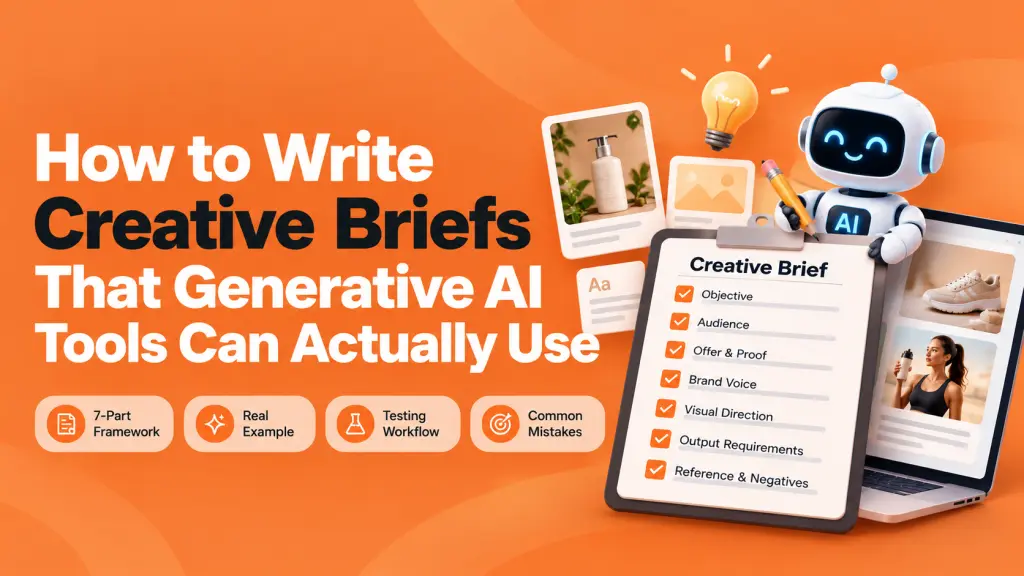
The 7-Part Framework for Creative Briefs That Generative AI Tools Can Use
Gartner has predicted that by 2025, 30% of outbound marketing messages from large organizations will be synthetically generated. Teams scaling AI creative need a repeatable brief structure, not ad hoc prompting. Here it is.
1. Objective and Single Success Metric
State one goal and one number. For example: "Drive first-time purchases of our hydration powder, target CPA under $18."
AI tools optimize toward what you specify. If you list five goals, you get a muddy average of all five.
2. Audience in Behavioral Terms
Skip demographics-only descriptions. Give the model a specific person, tension, and trigger.
- Who: Women 28 to 40, gym-goers, tired of chalky supplements
- Pain: Bloating after protein shakes
- Trigger: New Year fitness reset, post-workout fatigue
3. Offer, Proof, and Claims Boundaries
List what the model can say and what it must never say. Include your hero offer, two proof points (reviews, certifications, results), and compliance guardrails.
This matters most in regulated D2C categories like supplements, skincare, and finance, where one hallucinated claim can get an ad account flagged.
4. Brand Voice With Examples
Adjectives are weak inputs. Paste three real examples of copy you love and three you hate, then add a short rule set:
- Sentence length: under 14 words
- Tone: witty, never sarcastic
- Banned words: "game-changer," "revolutionary"
5. Visual Direction and Technical Specs
Describe lighting, composition, palette (with hex codes), product placement, and format. Specify aspect ratios (9:16, 4:5, 1:1) and platform placements upfront.
A line like "natural window light, product centered, muted sage and cream palette, no text overlays" outperforms "clean and modern" every time.
6. Output Requirements
Tell the model exactly what to deliver. Ask for five hooks, three body variations, and two CTAs, each labeled by the angle it tests (price, social proof, problem-solution).
Structured outputs make AI creative easy to load into your ad platform and easy to analyze later.
7. Reference Assets and Negative Prompts
Attach winning ads, competitor examples, and product photography. Then add what to avoid: stock-photo smiles, cluttered backgrounds, generic benefit claims.
Negative instructions are underused and remove a surprising amount of mediocre output.
A Quick Before-and-After Example
Weak brief: "Write a Facebook ad for our protein powder. Make it fun."
Usable brief: "Objective: first purchase, CPA under $18. Audience: women 28 to 40 who bloat after shakes. Hook angle: 'Protein that doesn't hurt your stomach.' Proof: 4.7 stars from 3,200 reviews, third-party tested. Voice: witty, under 14 words per sentence. Output: 5 hooks, 3 bodies, 2 CTAs, tagged by angle."
The second version gives the model a job instead of a guess. Expect usable first drafts instead of a slog through ten rewrites.
How to Test and Refine Your AI Creative Briefs
Treat every brief as a hypothesis. Your creative brief template for AI tools should improve with each campaign cycle.
Use this loop:
- Generate 10 to 20 variations from one brief.
- Cull to the 5 best against your brand rules.
- Launch them in a structured test, one variable at a time.
- Feed winners back into the brief as reference examples.
This turns your brief into a learning system. Over time, your best-performing hooks, visuals, and proof points become permanent inputs, so the model gets closer to your brand with every round.
Pair this with a measurement setup that connects creative angles to revenue, not just click-through rates. You can see how we approach that in our results library.
Common Mistakes to Avoid
- Prompting without a brief. Ad hoc prompts can't be repeated or improved.
- Skipping human review. AI drafts need a brand and compliance check before launch.
- Overloading one brief. One campaign, one objective, one audience.
- Ignoring platform context. A TikTok hook and a Google Shopping headline need different briefs.
For more on scaling creative systems, browse our library of D2C growth guides.
Frequently Asked Questions
What is a creative brief for generative AI?
It is a structured document that gives an AI tool the objective, audience, offer, brand voice, visual direction, and output format needed to produce on-brand creative. It replaces vague prompts with specific constraints.
How long should an AI creative brief be?
Usually 300 to 600 words. That is long enough to cover all seven components, and short enough that the model stays focused on your priorities.
What is the difference between a creative brief and a prompt?
A brief is the strategic source document for a campaign. A prompt is the instruction derived from it for a specific task. One brief can generate dozens of prompts.
Can generative AI replace creative strategists?
No. AI speeds up production and variation, but humans still set strategy, judge quality, and protect brand integrity. Strong briefs are where that human judgment shows up.
Which AI tools work best with detailed creative briefs?
Large language models handle copy, hooks, and scripts well, while image and video generators respond best to visual direction and negative prompts. Any of them performs better with structured inputs.
How do I keep AI-generated ads on brand?
Include voice examples, banned phrases, hex codes, and reference assets in every brief. Then run a human review before anything goes live.
Turn Better Briefs Into Better Revenue
Writing creative briefs that generative AI tools can use is a skill, and it compounds. Brands that systematize it ship more tests, learn faster, and lower their cost to acquire customers.
At Global Surat, we build AI creative systems for D2C brands across India, the US, UK, Canada, Australia, and Europe, connecting briefs, production, and performance data in one workflow. Explore our services to see how SEO, performance marketing, web development, and AI creative work together.
Ready to scale creative without scaling chaos? Book a strategy consultation with Global Surat and we will audit your current briefing process, then map a plan to get more from your AI tools. Start at globalsurat.com.
Make this useful