
SEO
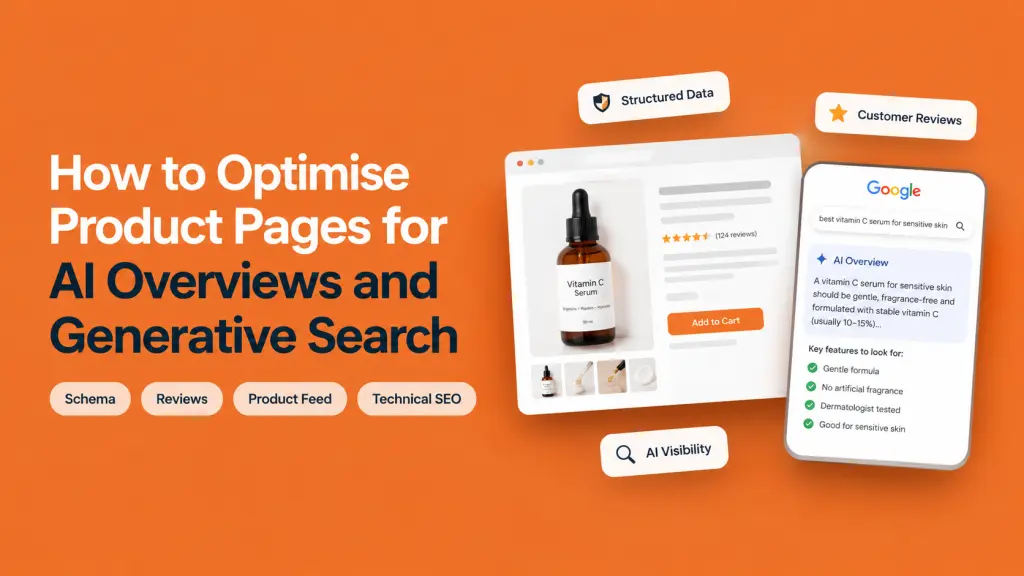
How to Optimise Product Pages for AI Overviews and Generative Search
Discover how D2C brands can optimise product pages for AI Overviews and generative search with clearer structure, schema, reviews and feeds.

When a shopper asks Google for “the best vitamin C serum for sensitive skin,” the AI answer often appears before a single blue link. If your product page isn’t feeding that answer, your competitor’s is.
Google’s AI Overviews now reach over 2 billion monthly users, according to Google’s own 2025 reporting. To optimise product pages for AI Overviews and generative search, you need pages that machines can parse, trust and quote, while humans still want to buy from them. This guide covers the exact changes D2C brands should make: content structure, schema, reviews, feeds and technical foundations.
Why Generative Search Changes Product Page SEO
Classic SEO rewarded pages that ranked. Generative search rewards pages that get cited.
A 2025 Pew Research Center study found that users clicked a traditional result in 8% of visits when an AI summary appeared, versus 15% when it did not. Fewer clicks means every citation and every click matters more.
What this means for your store:
- Visibility now includes being named inside AI answers, not just ranking.
- Product pages compete with editorial content, so thin copy loses.
- Clarity beats cleverness. Models favour pages that state facts plainly.
Our insights hub tracks how these shifts affect D2C traffic, if you want to go deeper.
Structure Product Page Content for Generative Search
AI systems extract passages. Your job is to make those passages easy to lift.
Lead with a direct answer
Open the description with one or two sentences covering what the product is, who it is for and its core benefit. Think of it as the answer a shopper would want read aloud.
Add a specs block and a comparison block
Place specs in a clean table or list: dimensions, materials, ingredients, compatibility, warranty. Then add a short “How it compares” section against the alternatives shoppers actually consider.
Answer real questions on the page
Pull questions from customer support tickets, reviews and “People Also Ask.” Add 4 to 6 on-page Q&As. Write them in the language customers use, such as “Is this safe for sensitive skin?” rather than “Product suitability.”
Quick wins:
- Use one H1 with the product name and primary use case.
- Use H2s phrased as questions or clear topics.
- Keep paragraphs short and specific.
- Replace vague claims like “premium quality” with measurable facts.
Use Structured Data to Speak the Language of AI
Schema markup is how you tell machines exactly what your page contains. Google’s published case studies show the payoff: Nestlé reported rich result pages with an 82% higher click-through rate, and Rotten Tomatoes saw a 25% lift after adding structured data.
Schema types every product page needs
- Product: name, image, description, SKU, GTIN, brand
- Offer: price, currency, availability, shipping and return details
- AggregateRating and Review: only where reviews are visible on the page
- FAQPage: for your on-page Q&A section
- BreadcrumbList: for clear site hierarchy
Google’s guidance is clear that markup must match visible page content. Hidden or inflated data risks losing eligibility. Implement it as JSON-LD, validate it in Google’s Rich Results Test, and monitor it in Search Console.
Our technical SEO and web development team builds and audits this layer as part of technical SEO and web development engagements.
Build Trust Signals That AI Systems Can Verify
Generative engines try to avoid recommending products they cannot trust. Reviews, proof and brand clarity are the evidence they look for.
Research from Northwestern’s Spiegel Research Center found that a product with just five reviews can be up to 270% more likely to convert than one with none. Those same reviews give AI systems rich, specific language to draw on.
Strengthen your evidence layer
- Collect detailed reviews that mention use cases, sizing and results.
- Show reviewer context, such as skin type, body type or verified purchase.
- Display certifications, lab tests and awards in text, not just images.
- Add author or expert review credits to buying guides linked from product pages.
- Keep brand facts consistent across your site, Google Business Profile, marketplaces and press mentions.
See how this plays out in practice in our evidence section.
Sync Product Feeds and Merchant Data
Google’s Shopping Graph holds over 50 billion product listings, with billions refreshed every hour, per Google. Generative shopping experiences draw heavily from it, so your feed is as important as your page.
Checklist for feed health:
- Complete every recommended attribute in Google Merchant Center, including GTINs, colour, size, material and age group.
- Match feed price and stock to the on-page values exactly.
- Use high-quality, multi-angle images and short lifestyle video where possible.
- Fix disapprovals fast. A mismatched price can pull a product out of shopping surfaces entirely.
Nail the Technical Foundation
Even the best content fails if crawlers cannot reach it or shoppers bounce.
A Google and Deloitte study found that a 0.1 second improvement in mobile site speed lifted retail conversions by 8.4%. Speed helps both users and crawlers.
Technical must-dos:
- Keep key content in server-rendered HTML, not behind JavaScript tabs that bots may miss.
- Allow Googlebot and reputable AI crawlers in robots.txt unless you have a deliberate reason not to.
- Use clean canonicals for variants so signals are not split.
- Maintain strong Core Web Vitals, especially on mobile.
- Submit a clean XML sitemap with accurate lastmod dates.
How to Measure Results
AI visibility is harder to track than rankings, but it is measurable.
- Search Console: watch impressions and clicks for product and long-tail question queries.
- Manual prompt testing: run 20 to 30 buyer-style prompts monthly across Google, ChatGPT and Perplexity, and log whether you are cited.
- Analytics: track referral traffic from AI platforms and branded search growth.
- Revenue metrics: judge success on conversion rate and assisted revenue, not traffic alone.
Frequently Asked Questions
What are AI Overviews in Google Search?
AI Overviews are AI-generated summaries that appear at the top of some Google results. They combine information from multiple sources and link to the pages they draw from.
Can you optimise product pages for AI Overviews?
Yes. Use clear, factual copy, complete Product and Offer schema, verified reviews, accurate Merchant Center feeds and fast, crawlable pages. These improve the odds of being cited.
Does schema markup help with generative search?
Schema helps machines understand your product, price, availability and ratings. It is not a guarantee of citation, but it removes ambiguity and supports rich results and shopping visibility.
Is generative engine optimisation different from SEO?
It builds on SEO. Core practices like crawlability, relevance and authority still apply, but generative search adds emphasis on quotable answers, entity clarity and third-party trust signals.
How long does it take to see results?
Technical and schema fixes can show up within weeks of recrawling. Content and review improvements usually take two to four months to influence visibility consistently.
Do reviews really affect AI recommendations?
Yes. Detailed, verified reviews give AI systems specific, trustworthy language to reference and boost conversion once shoppers land on your page.
Which products benefit most from this approach?
Considered purchases such as skincare, supplements, electronics, home goods and fashion, where shoppers research before buying, see the biggest gains.
Turn AI Search Into Your Next Growth Channel
AI search is already deciding which D2C brands get recommended. The brands that structure, prove and publish their product data well will keep winning those moments.
Global Surat helps D2C brands across India, the US, UK, Canada, Australia and Europe build product pages that rank, get cited and convert. Ready to see where your product pages stand?
Visit Global SuratBook a strategy consultation today.
Make this useful